Institutional framework

A principled framework for lasting humanitarian impact.

RAHMA Global Society operates within a defined strategic framework and transparent governance structure — ensuring that every program, partnership, and decision serves the society's humanitarian mission with integrity and accountability.

Strategic Period 2024 – 2028
Our vision

A world where every community has access to dignity, safety, and sustainable opportunity.

Al Rahma International operates in accordance with best practices in developing its financial and human resources, while ensuring the breadth, quality, reach, and impact of its humanitarian and development projects.

Our mission

Developing individuals and contributing to the improvement of their lives through charitable activities, partnerships, and various initiatives, particularly those focused on education.

Through local knowledge, trusted partnerships, and rigorous program delivery, RAHMA addresses immediate humanitarian needs while building the foundations for lasting community resilience — guided at every step by transparency, dignity, and respect for those we serve.

Governance structure

Clear lines of authority, accountability, and oversight.

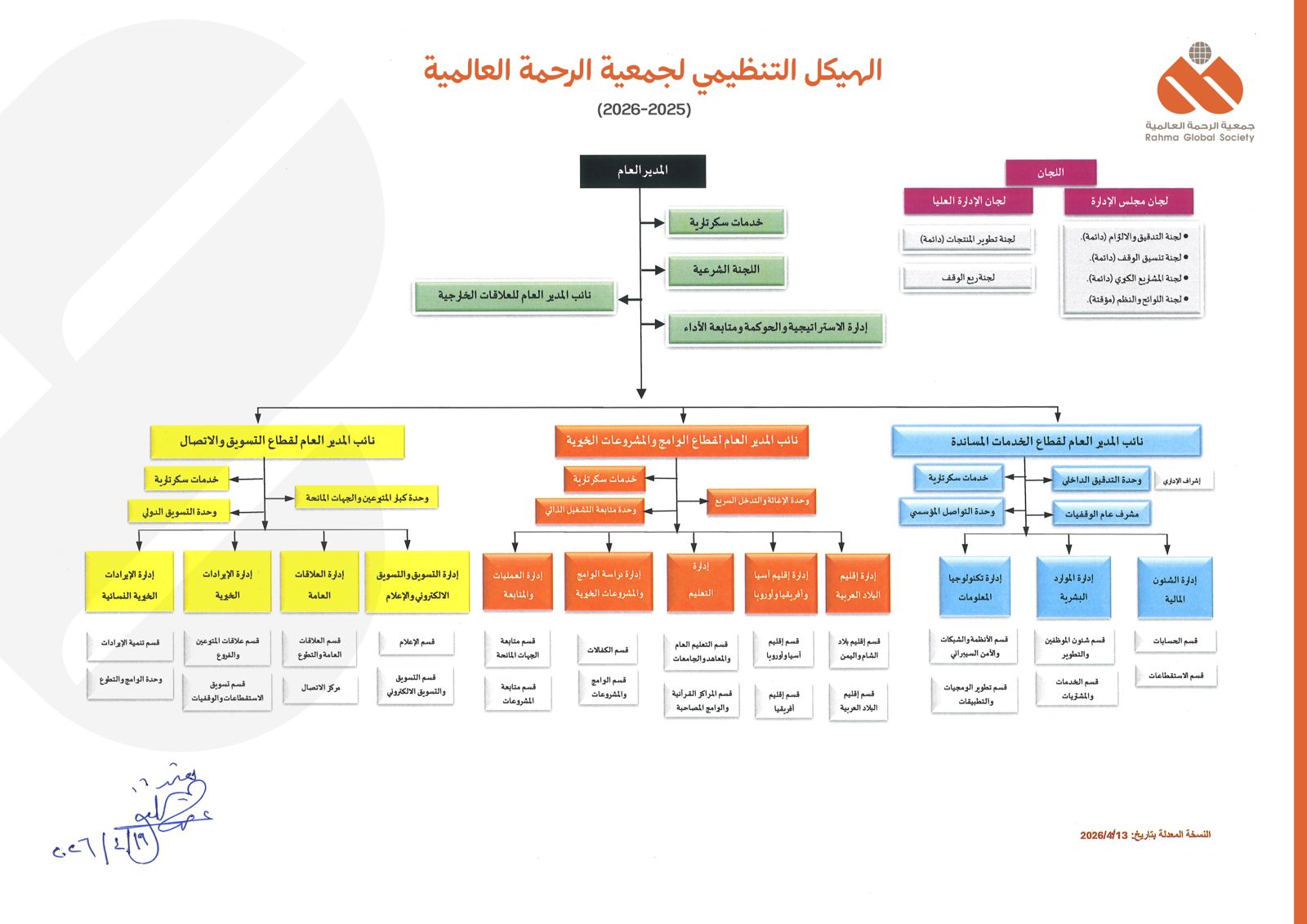
RAHMA Global Society governance structure

Built for trust, accountability, and mission alignment.

RAHMA's governance model separates strategic oversight from operational management, ensuring that the Board of Directors provides independent accountability while executive leadership drives effective daily delivery. This structure protects the integrity of the society's humanitarian mission and the trust of its donors and beneficiaries.

All departments are accountable to the Director General, who reports to the Board. Financial reporting, program audits, and external reviews form part of our regular accountability cycle, ensuring that every aspect of RAHMA's work is subject to principled oversight.

Meet the Board of Directors
Core values

The principles that define how we work, not just what we do.

Institutionalism and Responsibility

We are committed to responsible institutional work based on governance, transparency, and efficiency, ensuring that charitable resources are directed to those in need in the most effective manner. We take responsibility toward our communities, partners, and beneficiaries, striving to create sustainable impact that reflects the trust of our donors and strengthens our humanitarian mission.

Trust and Integrity

We uphold trust and integrity in all our work, guided by transparency, honesty, and a firm commitment to fulfilling our responsibilities toward our donors, partners, beneficiaries, and communities. We safeguard the trust placed in us by managing resources responsibly and ensuring that every act of giving reaches its intended purpose with integrity and accountability.

Excellence and Impact

We strive for excellence in every initiative we undertake, seeking to maximize the value and benefit of every contribution and charitable effort. We measure our success by the lasting impact we create in the lives of beneficiaries and the communities we serve, turning acts of kindness into sustainable change.

Collaboration and Integration

We believe that collaboration and integration are essential to maximizing the impact of humanitarian and charitable work, bringing together efforts, expertise, and resources toward shared goals. We build strong partnerships with organizations and individuals to create complementary efforts that deliver greater value and sustainable impact to those we serve.

Governance and Professionalism

We are committed to sound governance and professional practices that ensure transparency, accountability, efficiency, and responsible decision-making across all our operations. We continuously develop our systems, capabilities, and performance standards to uphold institutional excellence and deliver our humanitarian mission with the highest levels of professionalism.

Our Methodology

How does Al-Rahma put accountability and auditing into practice?

  • The methodology aims to systematically verify that all departments and organizational units comply with applicable regulatory requirements, particularly those issued by the Ministry of Social Affairs and the Ministry of Foreign Affairs, as well as the Association’s internal policies, regulations, and decisions. The methodology consists of the following key stages: Identify regulatory and internal requirements and convert them into clear, measurable compliance controls. Develop a risk-based periodic assessment plan, prioritizing activities with higher regulatory, financial, and operational risks. Collect evidence and verify actual implementation through reviewing documents, records, reports, samples, and interviews when needed. Assess compliance with each control and classify findings according to their severity, impact, and likelihood of recurrence. Prepare compliance reports outlining the level of compliance, potential gaps or violations, their causes, and required corrective actions. Monitor corrective actions against defined timelines and responsibilities, and verify that findings are closed and do not recur. Report periodic results to senior management and relevant committees to support decision-making and safeguard the Association’s regulatory standing and institutional reputation.
  • The Risk Management Methodology aims to protect the Association’s mission, assets, reputation, and business continuity by proactively identifying risks that may affect the achievement of its strategic, operational, financial, regulatory, and humanitarian objectives. The methodology follows these key stages: Define the context and objectives by linking risks to strategic and operational goals, programs, projects, and regulatory obligations. Identify potential risks across departments, operations, offices, and projects, including financial, compliance, reputational, program, security, technology, and partnership risks. Analyze risks based on their likelihood and potential impact, and determine their severity using the approved risk matrix. Assess and prioritize risks for treatment in line with the Association’s risk appetite and tolerance. Develop appropriate risk treatment plans, including avoiding, reducing, transferring, or accepting risks, with defined controls, responsibilities, and timelines. Record risks and treatment plans in a centralized risk register and update it regularly as conditions or risk indicators change. Monitor, report, and learn by tracking risk indicators, reporting to management and relevant committees, and continuously reviewing and improving the effectiveness of risk treatments.
  • The Sharia Audit Methodology aims to verify that the Association’s activities, projects, and related transactions comply with Sharia principles and requirements, thereby strengthening the integrity of charitable work and maintaining the trust of donors, beneficiaries, and partners. The methodology includes the following key steps: Consult the Sharia Committee on project-related matters and fatwas, particularly during marketing and implementation, and obtain Sharia opinions on emerging issues. Incorporate approved Sharia guidance and fatwas into relevant procedures and controls and communicate them to the concerned departments. Conduct an independent annual external Sharia audit through Shoura Sharia Audit Company, based on an approved audit scope and plan. Review samples of relevant policies, procedures, documents, records, operations, and projects to verify compliance with approved Sharia requirements and rulings. Document Sharia findings, analyze their root causes, and define corrective actions, responsibilities, and timelines. Issue an annual Sharia audit report covering the Sharia opinion, findings, and recommendations, and submit it to senior management, the Sharia Committee, and relevant authorities. Follow up on recommendations and close findings, using audit results to improve controls and procedures and continuously strengthen Sharia compliance.
Learn more

Governance and strategy in the service of one purpose.

Every element of RAHMA's governance framework exists to protect and strengthen its humanitarian mission. Explore the board, leadership team, and impact data to understand the full picture.